Tracing Community Patch Interpretations That Shift Hardware Preferences Across Simulation Ecosystems
Casey Zimmermann · Aug 26, 2026

Tracing Community Patch Interpretations That Shift Hardware Preferences Across Simulation Ecosystems
Simulation ecosystems encompass flight trainers, racing platforms, and urban planning tools where software updates reshape performance baselines, and community forums track these alterations through benchmark data that influences collective hardware decisions over time. Patches frequently modify rendering pipelines, physics calculations, and memory allocation routines, while participants in dedicated discussion threads compile results from multiple configurations to identify which components deliver stable frame rates under new conditions.
Patch Mechanics and Initial Community Responses
Developers release patches that adjust core simulation variables such as draw distances, particle densities, and AI pathfinding loads, and these modifications prompt immediate testing cycles among users who operate standardized hardware suites to measure differences in CPU utilization and GPU throughput. Observers note that early interpretations often focus on isolated metrics like minimum frame rates during peak events, yet broader patterns emerge when aggregated reports compare pre-patch and post-patch outcomes across diverse processor generations and graphics architectures.
Research from the Entertainment Software Association indicates steady growth in simulation software adoption through 2025, and this expansion coincides with increased forum activity where contributors share configuration files that optimize for revised engine behaviors. Data collected from industry surveys shows participants reallocating resources toward components with stronger multi-threaded capabilities when patches emphasize parallel processing demands.
Hardware Preference Evolution Patterns
Communities evaluate how specific updates affect thermal profiles and power consumption, and these evaluations lead to revised lists of recommended components that prioritize sustained performance over peak theoretical speeds. Studies from academic institutions in Canada have documented shifts where users transition from high-clock single-core processors to balanced multi-core systems after patches introduce more complex entity management routines in large-scale simulations.
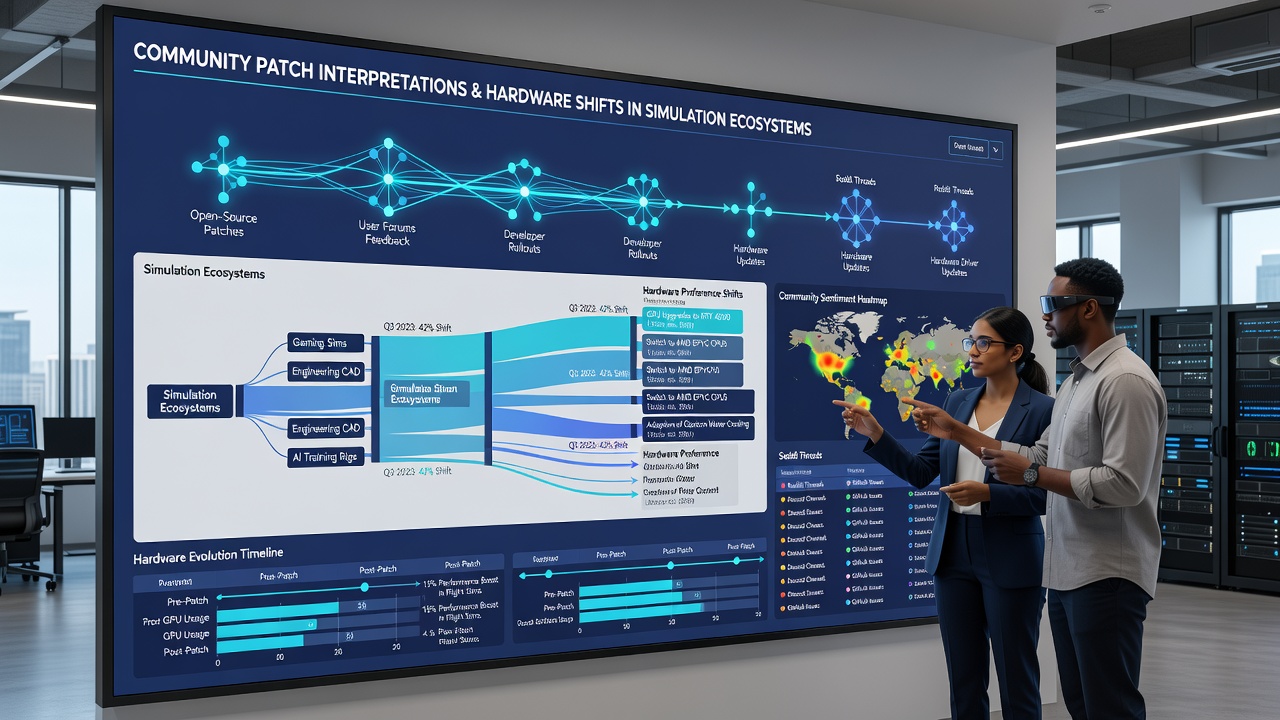
European Games Developer Federation reports highlight regional variations in hardware upgrades, with participants in different markets responding to the same patch based on local availability of memory modules and storage solutions that support faster asset streaming. Figures reveal that preferences move toward solid-state drives with higher endurance ratings when patches increase background data loading during extended sessions, and this trend appears consistent across multiple ecosystem types.
Case Examples from Major Simulation Titles
One documented instance involves a major flight simulation update in early 2026 that altered weather rendering algorithms, prompting users to favor graphics cards with expanded VRAM capacities according to aggregated forum statistics. Another example centers on a racing platform patch that refined tire physics models, after which contributors reported improved stability on systems equipped with faster system memory rather than raw GPU horsepower alone.
Trade group analyses from Australia demonstrate that these interpretation cycles repeat across annual update schedules, and each iteration refines the collective understanding of which hardware attributes matter most under evolving simulation loads. Participants often cross-reference results from multiple titles within the same ecosystem to isolate variables that patches affect universally versus those unique to individual software branches.
Trends Observed Through Mid-2026
By August 2026, tracking mechanisms within simulation communities incorporated automated logging tools that capture performance deltas immediately following patch deployment, and these tools accelerate the speed at which hardware preference lists update across global user bases. Industry reports note continued emphasis on power efficiency metrics as patches introduce more sophisticated simulation layers that increase overall system demands without proportional gains in visual fidelity alone.
University-led examinations of user behavior patterns indicate that hardware shifts occur most rapidly when patch notes include explicit references to optimization changes, prompting faster consensus formation around particular component combinations. External factors such as new driver releases from hardware manufacturers interact with these community findings to further refine recommendations over successive months.
Conclusion
Community-driven analysis of patch interpretations continues to guide hardware selection processes within simulation ecosystems, and the resulting preference shifts reflect measured responses to documented performance changes rather than isolated speculation. Ongoing data collection from industry associations and research bodies supports continued examination of these dynamics as simulation software evolves through future updates.